Congressional stock trades filed in mid-November 2026 are dominated by two House batches, not a broad Senate wave. As of November 14, 2026, ProBors shows 77 deduplicated disclosure rows with filing dates from November 9 through November 12 across four House members and no new Senate PTR lines in that window. Rep. Gilbert Cisneros filed 61 lines on November 9, mixing municipal-bond activity with equity purchases such as MTSI (MACOM Technology Solutions). Rep. David Taylor posted 12 trust lines on November 12, including a Worth watching Eaton (ETN) purchase. This is research context, not investment advice.
Snapshot summary
ProBors sorts congressional disclosures by filing date. In the November 9–12 filing window:
- 77 rows after deduplication (identical politician, ticker or asset description, transaction type, trade date, filing date, amount, and chamber removed)
- 4 politicians with at least one filing: Gilbert Cisneros (61), David Taylor (12), Richard W. Allen (3), Julie Johnson (1)
- Chamber split: 77 House rows, 0 Senate rows
- Transaction mix: 41 purchase-type rows, 36 sales
- Signal tiers: 24 Worth watching, 52 Normal (no High-tier rows in this slice)
- Filing lag: 5-day minimum (Cisneros municipal lines with early-November trade dates), 20-day median, 39-day maximum on Richard Allen’s Treasury note purchase
- Notable clusters: Cisneros’s November 9 equity-and-bond dump (61 lines), Taylor’s November 12 David Taylor Trust batch (12 lines across semiconductors, staples, and industrials), and smaller trims from Allen and Johnson with Worth watching flags on SHW and WBD
Compared with early November’s seventeen-row week, mid-November is larger and more concentrated: two members account for roughly 95% of rows. Over the prior 14 days, ProBors still shows lighter repeat activity on names such as ETN, GOOGL, and KR—mostly from Taylor’s overlapping trust filings rather than a coast-to-coast rotation.
Recent disclosures worth a closer look
The table below shows deduplicated rows from ProBors as of November 14, 2026. Lag is calendar days between transaction date and filing date as reported in each disclosure.
| Politician | Chamber | Ticker / asset | Type | Traded | Filed | Lag | Amount range | Signal |
|---|---|---|---|---|---|---|---|---|
| Gilbert Cisneros | House | MTSI | Purchase | October 27, 2026 | November 9, 2026 | 13 days | $1,001–$15,000 | Worth watching |
| Gilbert Cisneros | House | BBIO | Purchase | November 2, 2026 | November 9, 2026 | 7 days | $1,001–$15,000 | Normal |
| Gilbert Cisneros | House | Wisconsin HEFA revenue bonds (no equity ticker) | Sale | October 9, 2026 | November 9, 2026 | 31 days | $250,001–$500,000 | Normal |
| David Taylor | House | ETN | Purchase | November 3, 2026 | November 12, 2026 | 9 days | $1,001–$15,000 | Worth watching |
| David Taylor | House | LRCX | Purchase | November 5, 2026 | November 12, 2026 | 7 days | $1,001–$15,000 | Normal |
| Richard W. Allen | House | SHW | Sale (partial) | October 9, 2026 | November 10, 2026 | 32 days | $1,001–$15,000 | Worth watching |
| Julie Johnson | House | WBD | Sale | October 7, 2026 | November 9, 2026 | 33 days | $1,001–$15,000 | Worth watching |
How to read this without overfitting:
- Cisneros’s November 9 batch is the volume story: dozens of lines filed on one date, spanning municipal purchases and sales in the $250,001–$500,000 brackets plus smaller equity tickets such as MTSI and BBIO. The MTSI line carries a Worth watching label with reversal-and-price context in ProBors—not a verdict on intent.
- Taylor’s November 12 trust filing packages semicap names (LRCX), staples (PG sales elsewhere in the batch), and industrials (ETN) into one disclosure date. Trade dates sit in early November; lag runs about one week.
- Allen’s November 10 lines pair a partial Sherwin-Williams (SHW) sale with a Treasury note purchase—fixed-income detail matters as much as the equity trim.
- Johnson’s WBD sale is a single House row with a 33-day lag from an October 7 trade date—easy to misread as “this week’s media trade” if you only scan the filing date.
Filing lag in plain language
STOCK Act disclosures are periodic reports, not live trade feeds. In this mid-November snapshot:
- Fastest fresh trades: Cisneros’s early-November municipal purchases at roughly 5- to 7-day lag
- Typical equity lag: Taylor’s November 3–5 trust trades filed November 12 at 7- to 9-day lag
- Slower House rows: Allen, Johnson, and Cisneros bond sales with trade dates in early October filed in November at 31- to 33-day lag
When headlines imply “Congress traded this ticker today,” compare both dates. A November 12 filing can describe trades from the prior week—or, for bond lines, from October. For the rules behind that gap, see STOCK Act filing delay explained.
How to research this week's filings on ProBors
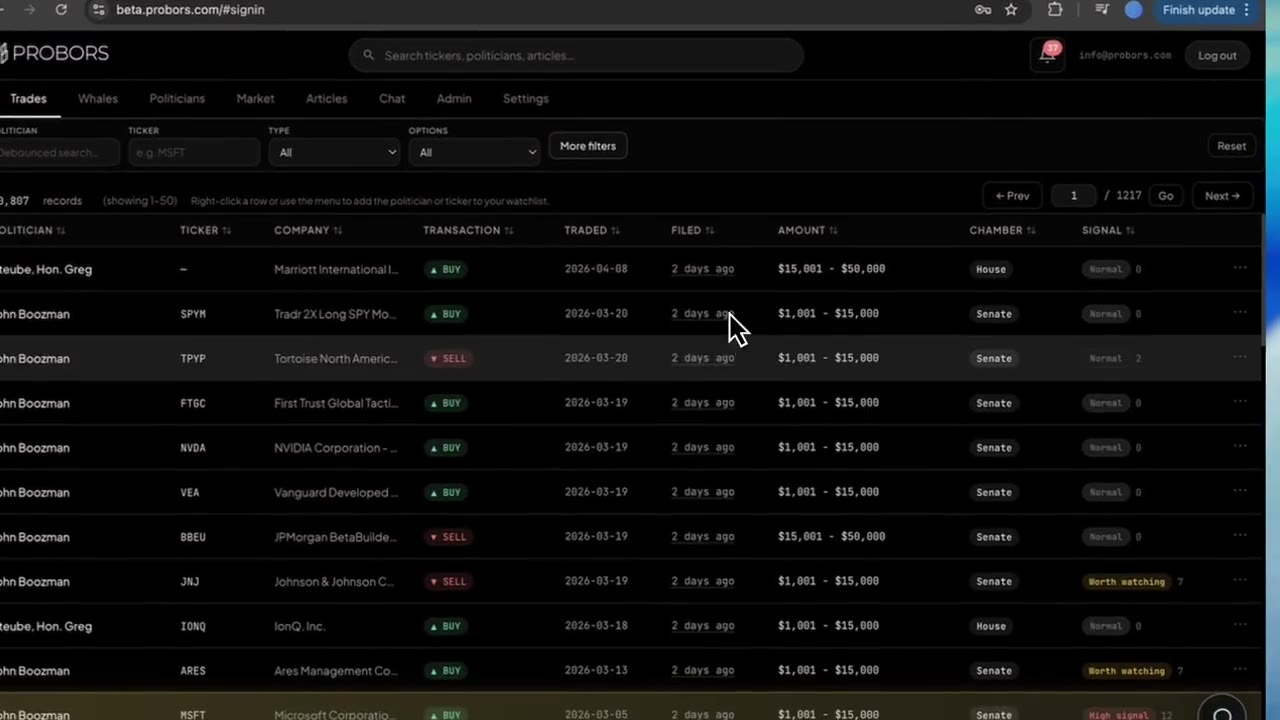
- Open Congressional trades and sort by filing date descending to mirror this snapshot.
- Filter to House when you want concentrated batches like Cisneros’s November 9 dump or Taylor’s November 12 trust cluster.
- Search a politician name to collapse dozens of lines into one research thread before you export notes.
- Sort by signal score when you want Worth watching rows first—MTSI, ETN, SHW, and WBD are good examples in this window.
- Open the original PTR PDF for any row you plan to cite; amount bands are ranges, not exact dollars.
For deeper context on BridgeBio lines in the same batch, see BBIO congressional disclosures explained.
What this does not prove
A heavy filing week does not mean members traded that calendar week. Cisneros’s November 9 batch bundles October and early-November trade dates; Taylor’s November 12 filing describes trust activity from November 3–5. Small $1,001–$15,000 brackets can reflect rebalancing rather than a directional call. Municipal bond rows are not stock picks. Worth watching labels highlight disclosure context in ProBors—they do not establish non-public information, committee conflict, or timing around pending legislation.
FAQ
How many congressional trades were filed in mid-November 2026?
ProBors shows 77 deduplicated disclosure rows with filing dates from November 9 through November 12, 2026, across four House members. The count removes identical politician-ticker-type-date-amount-chamber duplicates.
Why is Gilbert Cisneros's November 9 filing so large?
The November 9 House filing contains 61 deduplicated rows, mixing municipal-bond transactions in large amount brackets with smaller equity purchases and sales. That pattern looks like a periodic portfolio report rather than a single-day trading sprint.
Were there any Senate disclosures in this window?
No. Every row in this November 9–12 slice is tagged House in ProBors. Senate batches may land on different weeks; filter by chamber before comparing to Senate tracker workflows.
Which tickers showed up most in congressional filings lately?
In this filing window, repeat equity codes include BBIO, MTSI, and WBD. Over the prior 14 days in ProBors, ETN and GOOGL also appear multiple times—often tied to Taylor trust lines rather than wide member participation.
Where can I verify these rows against original filings?
House PTRs are available through the House Clerk's disclosure search. Senate reports use the Senate eFD system. Rows were checked in ProBors and should be verified against the original filing. Ingestion health is summarized on the ProBors status page.
Track congressional filings as they land
Use ProBors to sort House PTR rows by filing date, signal score, and politician—then open the original disclosure before you publish.
Get startedRelated reading
- Congress trades filed early November 2026
- BBIO congressional disclosures explained
- How to read politician trade disclosures
- House stock trading tracker
- How to research large congressional disclosure batches
Sources
- House Clerk financial disclosure search
- STOCK Act (Pub. L. 112-105)
- Senate Select Committee on Ethics — financial disclosure
- Rows were checked in ProBors and should be verified against the original filing.
Sources & methodology
Last updated:
ProBors uses public disclosure records, SEC filings, House and Senate financial disclosure portals, market data, and in-product workflow checks. Articles are written as research education, not investment advice.