STOCK Act reportable transactions are the individual securities trades and similar events that members of Congress—and certain spouse, dependent, and joint accounts—must list on a Periodic Transaction Report (PTR) once activity crosses the statutory dollar threshold. Not every portfolio move is reportable; not everything on a PTR is a directional stock bet. Knowing which events must hit a PTR—and which routine moves stay off the transaction log—keeps you from treating tracker silence as proof of no exposure, or a single sale line as full portfolio conviction. This guide explains coverage, common line types, and mistakes researchers make when they skim headlines without the ethics rules in view. It is research context, not investment advice.
What the STOCK Act added to congressional disclosure
Before the STOCK Act, annual financial disclosure schedules could leave weeks or months between a trade and public visibility. The Act requires periodic transaction reporting for reportable securities transactions so the public can see activity on a rolling basis—not only at the May annual deadline.
House filers use the House Clerk financial disclosure system; Senate filers use the Senate eFD portal. Ethics staff publish House PTR guidance that defines which transactions belong on the form and how soon filings are due.
PTRs are event logs: each qualifying transaction becomes a line with dates, amount bracket, asset description, and owner context. They are not a complete brokerage export. For gaps and omissions, see STOCK Act disclosure limits explained; this article focuses on what triggers a reportable line in the first place.
The $1,000 threshold (and why it is not a share count)
Ethics materials refer to reportable securities transactions above a $1,000 threshold in gross terms—not net profit, not annualized flow, and not your intuitive “materiality” bar for headline writers.
In practice that means:
- A purchase over $1,000 generally belongs on a PTR, even when the member still holds a much larger legacy position.
- A sale over $1,000 is reportable even if it is a partial trim of a larger holding.
- Trades at or below the threshold for that transaction typically do not generate a PTR line, even if the politician is active in the market.
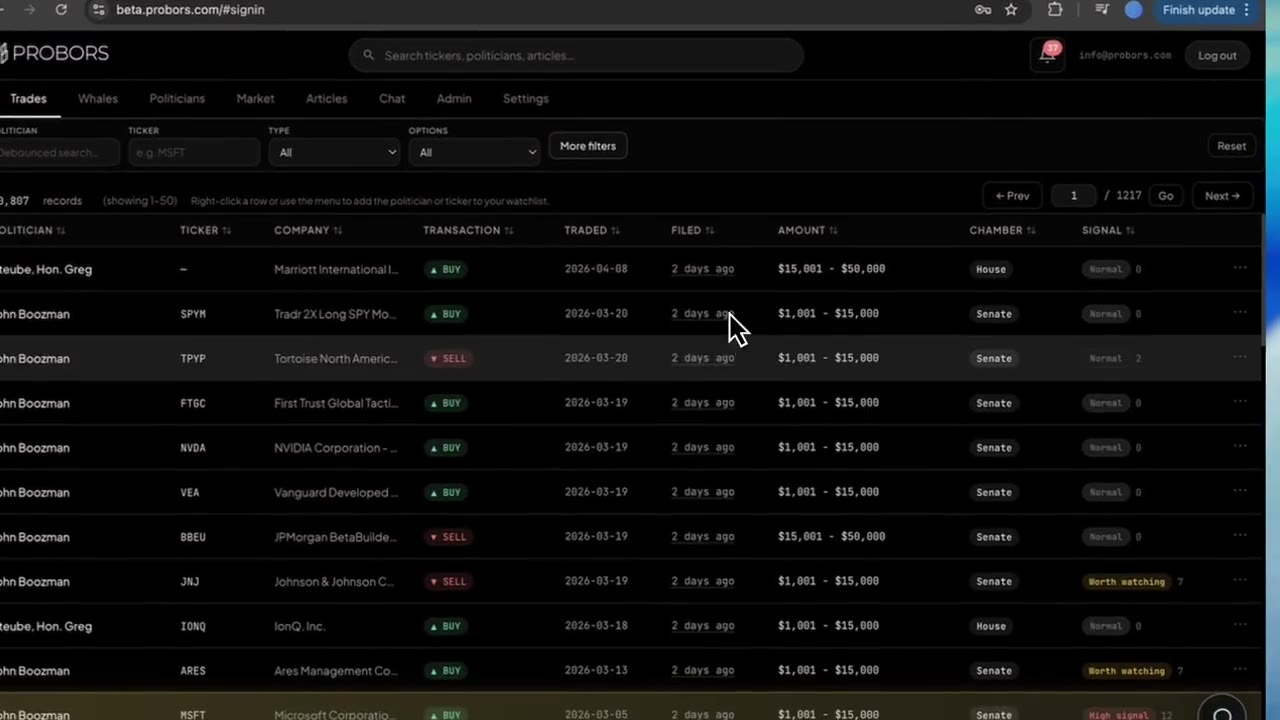
Trackers ingest PTRs. If you scan ProBors or any congressional feed and see “no trades” for a ticker, that shows no ingested reportable PTR lines for your filters—not proof the member never touched the name in a smaller size.
Amount columns on forms and in trackers reflect bracket ranges ($1,001–$15,000, and so on), not exact proceeds. Bracket math is covered in why congressional amount ranges are not exact dollars.
Who must report: member, spouse, dependent, and joint accounts
STOCK Act coverage extends beyond trades in a member’s personal brokerage. PTRs can include transactions attributable to:
- The member’s own accounts
- Spouse accounts and certain dependent children
- Joint accounts
- Trusts and other structures where ethics rules still require transaction-level reporting when the member has reportable ownership or control (details vary by arrangement—read the owner field in the PDF)
Owner context changes attribution. A call-option purchase in a spouse’s name is still a public PTR line, but the research narrative differs from a direct member purchase. For a verification workflow, see how to research spouse and joint congressional disclosures.
Transaction types that commonly produce PTR lines
Forms use short labels; trackers normalize them. These categories appear often in congressional feeds:
| Label family | What it usually means | Research note |
|---|---|---|
| Purchase | New or added exposure (stock, fund, bond, or similar) | Directional “buy” stories start here—after you confirm owner and asset type |
| Sale | Disposition presented as a full or general sale | May still be nuanced in the PDF description |
| Sale (Partial) | A trim, not necessarily an exit | Common in rebalancing; weak signal for “Congress dumped the stock” headlines |
| Exchange | Shares or interests swapped in a corporate action, merger, spin, or similar event | Often not a discretionary market call |
| Options and derivatives | Calls, puts, and related lines with contract detail | Premium brackets are not the same as notional equity size—see congressional options on ProBors |
| Non-equity assets | Municipal bonds, funds, structured labels | Ticker fields may be blank or misleading—see non-equity congressional disclosures |
Filtering by transaction type on probors.com before you interpret signal scores reduces mixed-direction noise. For step-by-step filters, see how to filter congress trades by transaction type.
When a PTR is due (reporting clock vs market clock)
A reportable transaction starts a deadline clock separate from when markets moved:
- House ethics guidance: PTR due by the earlier of 30 days from awareness or 45 days from the transaction date
- Senate filers follow the same core timing framework under Senate ethics rules
Public posting on Clerk or eFD portals can lag behind submission. Trackers add indexing time on top of that. Always separate transaction date, filed date, and when your tool first showed the row. For worked examples and lag habits, see STOCK Act filing delay explained and house vs Senate PTR deadlines.
PTR vs annual financial disclosure (different questions)
| If you are asking… | Start with… | Why |
|---|---|---|
| “Did they trade this security recently?” | PTR rows sorted by filing or trade date | Event-driven log |
| “What sectors or holdings did they report for the year?” | Annual financial disclosure schedules | Snapshot near the reporting deadline |
| “Why is there activity in March but silence in April?” | PTR calendar + member habits | No trade above threshold, batch filing, or non-reportable activity |
| “Is this a new position or a rebalance?” | PTR type + prior member history | Purchase vs partial sale context |
The congressional trading disclosure calendar maps both rhythms. Do not treat an annual holdings table as proof of a fresh trade—or the absence of PTR lines as proof of no holdings.
Common mistakes when judging reportability from a headline
-
Assuming every sale is voluntary bearishness. Partial sales, tax-lot management, and trust distributions can share a “Sale” label with very different intent.
-
Treating sub-threshold trading as “hidden.” Small trades may never appear on PTRs while still being lawful portfolio activity.
-
Ignoring exchanges and corporate-action lines. An “Exchange” row may reflect a mandatory conversion—not a timed exit.
-
Pooling spouse and member lines without owner checks. Attribution errors are ethics errors in published research.
-
Confusing PTR silence with “no exposure.” Holdings can persist without a reportable transaction during your window; annual schedules may still list the asset class.
-
Skipping amendments. A first PTR can be corrected—verify the latest published form before you cite dates or brackets. See amended congressional disclosures.
How to research reportable rows on ProBors
-
Open Trades when your question is whether a recent reportable event exists for a politician, ticker, or chamber.
-
Filter transaction type first (purchase vs partial sale vs options-only) so direction is not mixed by accident.
-
Click the row to open the disclosure context window and compare Traded vs Filed in plain language (for example “filed about three weeks after the trade”).
-
Follow the original filing link and confirm amount bracket, asset description, and owner code against the House or Senate PDF.
-
Use Politicians for member-level history when a single PTR line is not enough context.
-
If you expect a filing that has not indexed yet, check probors.com/status for ingestion health before assuming a reporting failure.
What this does not prove
Knowing which transactions are legally reportable on a PTR does not prove insider trading, ethical breach, or that a member chose timing for market advantage. It also does not turn bracket ranges into exact position sizes. Reportability answers a disclosure-design question—“did this type of trade have to be logged?”—not a guilt or alpha question.
FAQ
Does every stock trade by a senator or representative show up in trackers?
Only reportable securities transactions above the threshold on covered accounts, filed and published on a PTR (or equivalent periodic report), and ingested by your tool. Smaller trades, some structures, and holdings without a reportable event may leave no PTR footprint during your window.
Are Roth IRA or retirement account trades reportable?
Treatment depends on account ownership, control, and ethics guidance for that filer. Some retirement activity appears on PTRs; some is described on annual schedules. Read the account description in the source PDF instead of inferring from account type alone.
Is a purchase always bullish and a sale always bearish?
No. PTR labels describe disclosure categories, not investment thesis. Partial sales, option rolls, and exchange lines need PDF context before you attach a narrative.
Do cryptocurrencies always trigger PTR lines?
Classification and reportability depend on how the asset is held and how ethics guidance treats the transaction. Do not assume every digital-asset move mirrors an equity PTR line without reading the official filing category.
How do I confirm a row before sharing?
Use how to verify congressional trade disclosures before sharing as a checklist: source PDF, both dates, owner field, and amendment history.
Track PTRs with structure and source links
Filter congressional trades by type and chamber on ProBors, open original filings, and add names to your watchlist.
Get startedRelated reading
- STOCK Act disclosure limits explained
- How to read politician trade disclosures
- Congressional trading disclosure calendar
- Congress stock trading tracker
Sources
- STOCK Act (S. 2038, 112th Congress)
- House Committee on Ethics — Periodic Transaction Report (PTR)
- House Committee on Ethics — Instruction Guide (financial disclosure)
- U.S. House Clerk — Financial Disclosure
- U.S. Senate eFD search
- Rows were checked in ProBors and should be verified against the original filing.
- Ingestion health: probors.com/status
Sources & methodology
Last updated:
ProBors uses public disclosure records, SEC filings, House and Senate financial disclosure portals, market data, and in-product workflow checks. Articles are written as research education, not investment advice.