Congressional blind trust disclosures sit in an awkward middle ground for researchers: members may place assets in a trust specifically so they do not direct day-to-day trades, yet public ethics rules still require some visibility when qualifying trusts transact. A blind trust line on a Periodic Transaction Report (PTR) is not proof that the member timed a trade, and silence on a ticker is not proof that no trust exposure exists. This guide explains how qualified blind trusts interact with STOCK Act PTRs, what trackers typically show, and how to verify trust-related rows on probors.com without over-reading intent. It is research context, not investment advice.
Quick answer: blind trusts limit control, not all disclosure
Members who use a qualified blind trust—approved under House or Senate ethics procedures—hand trading authority to an independent trustee so they avoid directing individual securities decisions. That reduces conflict-of-interest risk while in office, but it does not turn trust activity into a fully invisible black box.
For House filers, ethics staff describe blind trust qualification and reporting expectations in the House Committee on Ethics financial disclosure section and in periodic PTR guidance linked from that site. Senate filers follow parallel rules published through Senate Select Committee on Ethics materials and file through the Senate eFD portal.
When a qualifying trust executes a reportable securities transaction, it can still produce PTR lines with trust or trustee language in the asset or owner fields. Annual financial disclosure may also list trust holdings as positions even when no new trade occurred. Researchers should treat trust rows as structure and timing facts, not as shorthand for “the member bought on inside information.”
How blind trusts differ from ordinary PTR rows
Most PTR lines describe a purchase or sale tied to a member, spouse, dependent, or joint account where the filer has direct awareness of the trade. Blind trust rows add a governance layer:
| Ordinary account PTR | Qualified blind trust PTR |
|---|---|
| Member or family often initiates or approves the trade | Independent trustee executes without member direction on specific securities |
| Owner field may say self, spouse, or joint | Description may reference a trust, trustee, or qualified blind trust |
| Trade timing may correlate with member awareness | Filing still public, but economic intent is more indirect |
| Useful for lag and direction research | Useful for exposure and compliance research, weaker for intent stories |
The STOCK Act focused on transaction transparency, not on forcing members to liquidate every investment. Ethics programs allow blind trusts as one way to wall off decision-making while keeping certain transactions on the public record.
If your question is strictly “did the senator personally click buy?”, open the House Clerk financial disclosure search or Senate eFD PDF and read the owner and narrative lines. Trackers—including ProBors—structure those fields for sorting, but the official form text remains authoritative.
What ProBors shows for trust-related PTRs
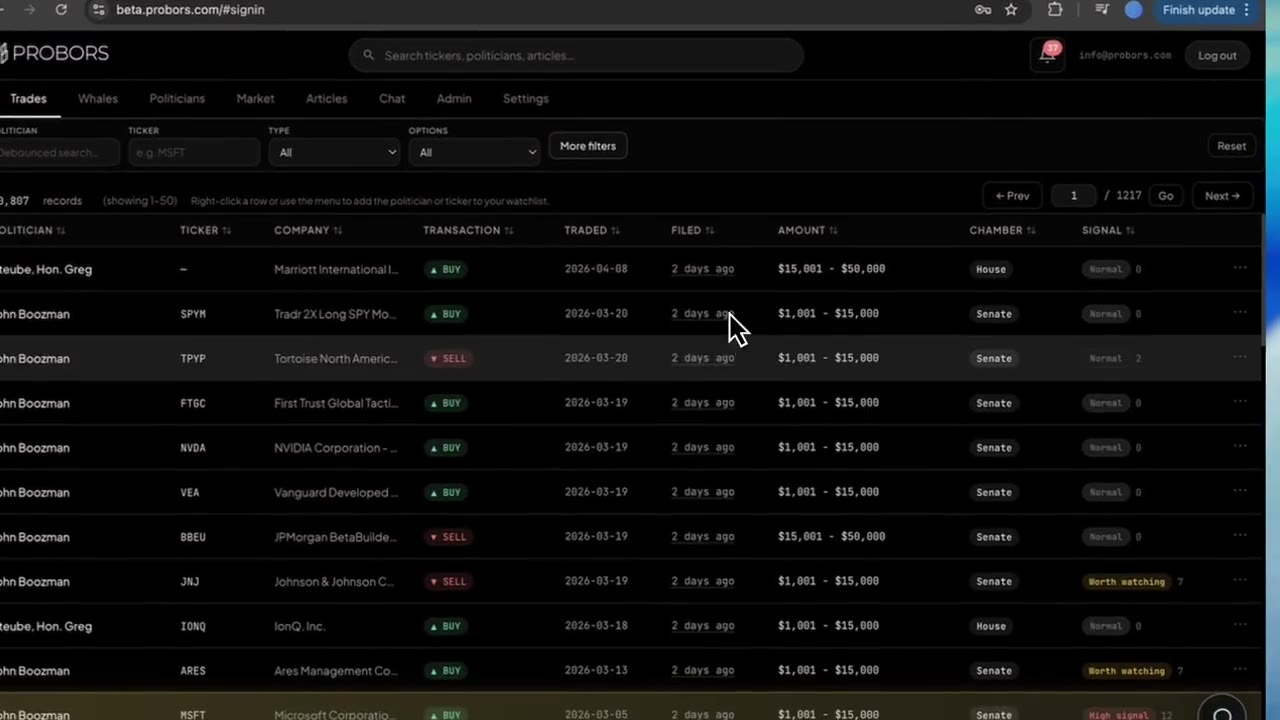
On Trades, trust-linked rows still carry the same core columns researchers use elsewhere: politician name, chamber, transaction type, transaction date, filed date, amount bracket, and asset description. When descriptions mention a trust, use transaction-type filters and text search to pull a consistent slice instead of mixing trust batches with direct account trades.
Useful habits on ProBors:
- Filter by politician on the member profile or Politicians tab, then scan owner and description language for trust references.
- Sort by filed date when a trust batch lands after month-end review—trustees sometimes file multiple lines in one submission.
- Compare transaction date vs filed date using the workflow in how to compare filing date vs transaction date; trust rows still carry lag, but lag measures disclosure timing—not member intent.
- Cross-check annual context in the congressional trading disclosure calendar when a May annual report lists trust holdings but your PTR feed looks quiet.
- Open original filing links through ProBors original filing links before quoting trust language in a memo.
ProBors also surfaces trust-style batches in dedicated workflow posts such as how to research congressional trust batch filings on ProBors. Treat those guides as operational help, not as proof of trading edge.
Common mistakes when researchers see “blind trust”
- Assuming “blind” means “no PTR.” Qualifying trusts can still generate reportable transaction lines when thresholds and asset types require disclosure.
- Treating trust silence as zero exposure. Holdings can appear on annual reports or prior PTRs even when no new trade fired this month.
- Copying tracker tickers without reading the PDF. Trust descriptions sometimes name funds, notes, or issuers where a clean equity symbol never appears on the form.
- Mixing trust trades with direct account trades in one narrative. Batch a trust slice separately before you write “the member traded tech this week.”
- Ignoring amendments. Corrected PTR or annual forms can change trust descriptions; see how to research amended congressional disclosures.
- Using amount brackets as exact dollars. Trust sales still use statutory ranges—see why congressional amount ranges are not exact dollars.
What blind trust disclosure does not prove
Public trust-related rows show that a reportable transaction was disclosed under ethics rules, with the dates and brackets on the form—not that the member:
- Knew the trade was coming before the public filing window
- Profited from non-public legislative information
- Chose the security being bought or sold inside the trust
- Holds no related exposure outside the trust structure
Members can also hold reportable assets outside a blind trust. STOCK Act disclosure limits still apply: sub-threshold trades, non-reportable asset classes, and timing gaps mean trackers are incomplete by design.
This is why ethics programs emphasize qualified trusts with independent trustees—not a label members can use to hide all market activity.
FAQ
Does every member of Congress use a blind trust?
No. Blind trusts are optional tools for managing conflicts. Many members file direct account PTRs without any trust language on the form.
If the trust is blind, why is there still a PTR line?
Ethics rules aim for transparency on reportable transactions even when the member does not direct the trade. The PTR documents the event; it does not recreate the trustee’s entire decision process.
Should I exclude blind trust rows from signal scoring?
Treat them as a separate cohort. Signal tiers on ProBors describe row-level disclosure context—they are not buy or sell instructions, and they weigh differently when the owner is a trust rather than a direct account.
Where do I confirm qualification language?
Use the official House or Senate disclosure PDF and ethics guidance pages. Tracker summaries are a starting point for search, not a substitute for the signed filing.
Can I see real-time trust trades?
No public feed offers real-time congressional trust activity. PTR deadlines remain measured in weeks under the STOCK Act, as explained in STOCK Act filing delay.
Separate trust batches from direct account trades
Use ProBors to sort congressional PTRs by member, dates, and disclosure context—then verify every row on the official filing.
Get startedRelated reading
- STOCK Act disclosure limits explained
- STOCK Act reportable transactions explained
- How to research congressional trust batch filings on ProBors
- How to research family LLC congressional disclosures
Sources
- STOCK Act (Pub. L. 112-105) — statutory basis for periodic transaction reporting
- House Committee on Ethics — Financial disclosure — blind trust qualification and PTR guidance
- House Clerk — Financial disclosure search — published House PTRs and annual reports
- Senate eFD search portal — published Senate periodic and annual reports
- Senate Select Committee on Ethics — Senate ethics resources
Rows were checked in ProBors and should be verified against the original filing. For ingestion health, see https://probors.com/status.
Sources & methodology
Last updated:
ProBors uses public disclosure records, SEC filings, House and Senate financial disclosure portals, market data, and in-product workflow checks. Articles are written as research education, not investment advice.