ROK congressional disclosures matter if you track industrial automation and factory-software names alongside mega-cap tech. Rockwell Automation (NYSE: ROK) is not a daily headline ticker, but it has shown up repeatedly in House Periodic Transaction Report (PTR) batches in 2026—mostly partial sales from one member in the fall, with smaller purchase activity from another representative earlier in the year. ProBors shows no Senate ROK lines in the most recent filing window below; the fresh activity is House-only. This spotlight summarizes recent rows, filing lag, and how to research the ticker without treating PTR data as a trading signal. It is research context, not investment advice.
Why Rockwell Automation shows up in congress trackers
ROK sits in the “industrial + software” bucket: automation equipment, control systems, and related services. Members who hold diversified equity sleeves—or names tied to manufacturing districts—can file ROK activity even when the ticker is absent from cable news. Useful questions are narrow:
- Who filed ROK in the last 90 days, and was it a purchase or partial sale?
- Do multiple sale lines land on the same filing date (batch reporting)?
- How many calendar days passed between the transaction date and the public filing date?
- Are amount brackets clustered in the $15,001–$50,000 band or stepping into $50,001–$250,000?
- Is there any Senate activity, or is the sample House-heavy?
A ticker spotlight should answer those fields from verified rows before you open charts or insider filings.
Recent ROK filings in ProBors
The table reflects ROK PTR rows in ProBors as of November 26, 2026, focused on disclosures filed since early September 2026, sorted by filing date (newest first). Filing lag is calendar days between the transaction date and the filed date as reported in ProBors. Rows are deduplicated on politician, transaction type, dates, amount, and chamber.
| Politician | Type | Traded | Filed | Lag (days) | Amount range | Chamber |
|---|---|---|---|---|---|---|
| Kevin Hern | Sale (Partial) | 11/17/2026 | 11/19/2026 | 2 | $50,001 - $100,000 | House |
| Kevin Hern | Sale (Partial) | 11/16/2026 | 11/19/2026 | 3 | $100,001 - $250,000 | House |
| Kevin Hern | Sale (Partial) | 09/17/2026 | 10/02/2026 | 15 | $15,001 - $50,000 | House |
| Kevin Hern | Sale (Partial) | 09/14/2026 | 09/15/2026 | 1 | $15,001 - $50,000 | House |
| Kevin Hern | Sale (Partial) | 09/02/2026 | 09/15/2026 | 13 | $15,001 - $50,000 | House |
| Ro Khanna | Purchase | 05/01/2026 | 06/09/2026 | 39 | $1,001 - $15,000 | House |
| Ro Khanna | Purchase | 04/24/2026 | 05/11/2026 | 17 | $1,001 - $15,000 | House |
Snapshot summary (filed since early September 2026): 5 deduplicated ROK partial sales on the House side, all from Rep. Kevin Hern, with two lines sharing a November 19, 2026 filing date and 1–3 day lags on those newest rows. The September cluster filed on September 15 and October 2, 2026, with lags from 1 to 15 days. Ro Khanna’s spring purchases are included for direction context—they are not part of the September–November sale batch.
ProBors flags the November Hern lines at a higher attention tier than the September partial sales, which is a triage hint only—open the original PTR before citing amounts or dates.
Always verify individual rows against the official source before sharing them:
- House PTR search: disclosures-clerk.house.gov
- Senate eFD search: efdsearch.senate.gov
Cross-chamber and member patterns
Three patterns stand out in this ROK sample—and none of them are buy or sell signals on their own.
1. One member, many partial sales on one filing day
The November 19, 2026 filing pairs two partial sales with transaction dates of November 16 and November 17, 2026 and amount ranges stepping from $50,001–$100,000 into $100,001–$250,000. That shape often looks like position trimming in brackets rather than a single-line exit. PTRs do not show exact share counts.
2. House-heavy, Senate-quiet in the recent window
All seven table rows are House PTRs. Older ProBors history on ROK includes other House members and occasional Senate names, but if you only watch “congress activity this month,” Senate silence can be real. Filter by chamber so a House batch does not hide a stale Senate line—see how to research a ticker across House and Senate.
3. Purchase vs sale direction can split by member
Rep. Ro Khanna’s 2026 purchases sit in the $1,001–$15,000 band with longer filing lag (for example, about 39 days on the May 1 trade filed June 9). That contrasts with Rep. Kevin Hern’s fall partial sales and short lags on the November batch. Industrial names can move in opposite directions across portfolios at the same time.
How to research ROK on ProBors
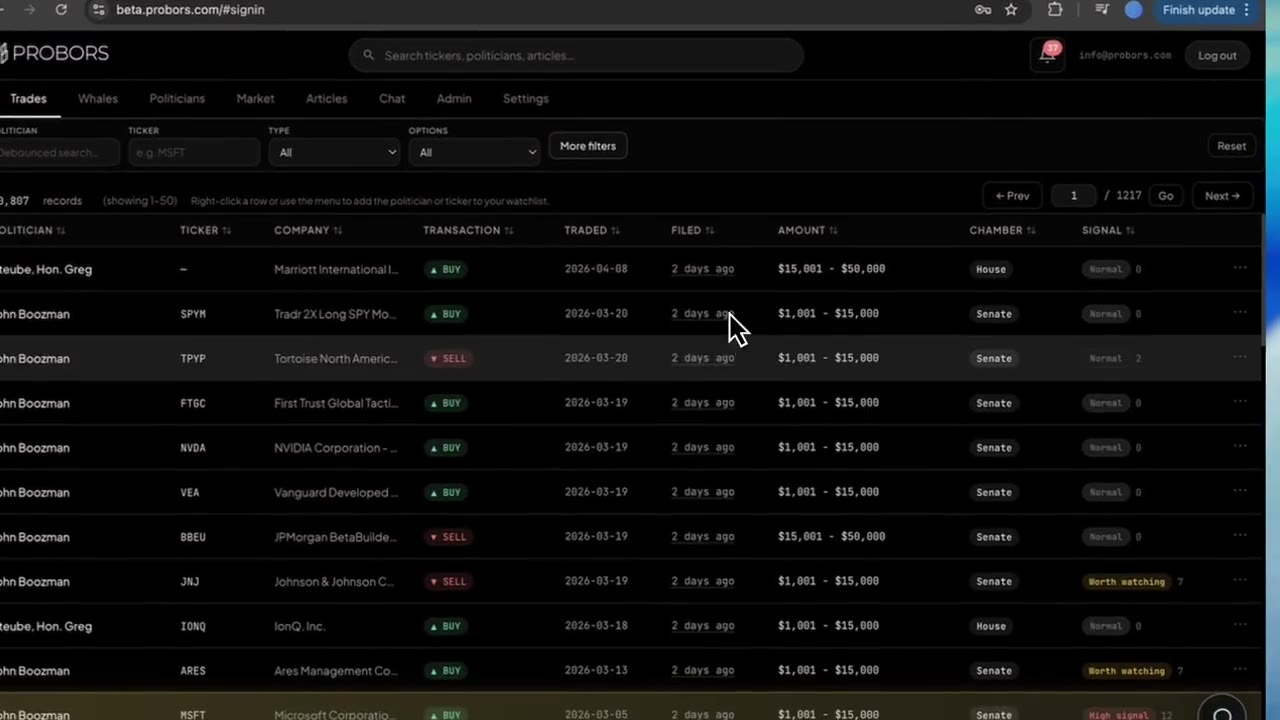
Use a ticker-first workflow when Rockwell Automation is on your watchlist:
- Open Market → ROK (or search
ROKin the dashboard). - Scroll to the Congress trades table and sort by filed date.
- Click a row to open trade context—transaction type, amount range, chamber, and signal tier when available.
- Toggle congress markers on the price chart to see where disclosures landed relative to daily bars.
- Cross-check Form 4 / whale activity on the same ticker before treating a PTR row as isolated.
- Add ROK to a watchlist if you want alerts on the next filing—not on live price.
For chart marker details, see the market chart congress markers guide. For sorting and filters on the trades grid, see the trades tab guide.
What this ROK data does not prove
A congressional disclosure table on Rockwell Automation does not prove:
- That members traded on non-public information
- That ROK will rise or fall because a PTR was filed
- Exact share counts or dollar proceeds (ranges are bands, not precise fills)
- Real-time intent—many rows post days or weeks after the transaction date
- Committee influence or federal procurement outcomes tied to a single ROK line
PTR data is a public record for transparency, not a timing edge. The useful output is a verified research trail: who filed, what type, when it traded, when it became public, and how that row compares to other disclosures on the same ticker.
FAQ
How active is ROK in congressional PTRs recently?
In ProBors, ROK ranked among the more active congressional tickers in the last 14 days as of late November 2026, driven by the Hern partial sales filed November 19, 2026. Activity is bursty—not a steady daily stream.
Why do two ROK sales share the same filing date?
Members often file multiple lines in one PTR batch. The November Hern pair both list November 19, 2026 as the filed date with adjacent transaction dates. Treat them as separate disclosures, not one merged trade.
What is typical filing lag for recent ROK House rows?
In the September–November 2026 Hern cluster, lag ranges from 1 day (September 14 trade filed September 15) to 15 days (September 17 trade filed October 2). The November lines posted after 2–3 days. Lag varies by member and batch, not by ticker—see the STOCK Act filing delay guide.
Are congressional ROK sales linked to insider Form 4s?
Not automatically. PTRs and SEC insider filings follow different rules, filers, and timelines. Keep congress rows and insider rows in separate lanes before drawing conclusions.
Has anyone in the Senate filed ROK lately?
The table above is House-only. If you need Senate coverage, search ROK with a Senate filter and open any hit against Senate eFD before citing it.
Research ROK disclosures in one workspace
Filter congressional PTRs by ticker, overlay markers on price, and cross-check insider filings on ProBors.
Get startedRelated reading
- Track congress stock trades by ticker
- CSCO congressional disclosures explained
- How to read politician trade disclosures
- Congress trades filed late November 2026
Sources
- House Financial Disclosure (PTR search)
- Senate eFD search
- STOCK Act (Pub. L. 112-105)
- SEC investor guidance on insider reporting
- Rows were checked in ProBors and should be verified against the original filing. Ingestion health: probors.com/status
Sources & methodology
Last updated:
ProBors uses public disclosure records, SEC filings, House and Senate financial disclosure portals, market data, and in-product workflow checks. Articles are written as research education, not investment advice.