LYV whale insider sales put Live Nation Entertainment on the late-November 2026 whale leaderboard—not for print-count dominance like ROKU or UTHR, but because two C-suite officers filed eight-figure open-market sales on consecutive trade dates. As of November 27, 2026, ProBors ranks LYV second on the 14-day whale board with 6 whale-class prints, 4 code S sales, and about $16.1 million in net reported value after option exercises offset part of the selling. CEO Michael Rapino and CFO Joe Berchtold account for most of the dollar volume, with EVP John Hopmans adding a same-day sale filed November 13, 2026. This guide unpacks the November 12–13 cluster, a five-step triage framework for paired exercise-and-sale weeks, and what officer-selling headlines do not prove. This is research context, not investment advice.
Why LYV surfaced on the November 2026 whale board
Live Nation is a large-cap entertainment name that rarely tops whale print-count leaderboards the way disposition-heavy tech stocks do. Three patterns explain why LYV still earns a second look in the last 14 days through November 27, 2026:
- C-suite concentration on two trade dates. Rapino filed three code S sales tied to November 12, 2026, each filed November 13 with a one-day lag. Berchtold filed three code S sales on November 13, filed the same day. Gross open-market selling on those dates totals about $54.1 million across 7 whale-class sale lines in ProBors.
- Option exercises sat in the same filing batch. ProBors indexes 4 code M exercise rows on November 12–13, 2026, with positive reported values near $8.1 million combined—typical of sell-to-cover or post-exercise sales, not a naked discretionary exit story without reading footnotes.
- Net dollars, not raw sales, drive the leaderboard rank. The 14-day whale board shows about −$16.1 million net reported value because exercises partially offset sales. That is why LYV can rank second on net dollars while names like VVVV show far more prints from grant and disposition codes.
Whale leaderboards are a prioritization queue. On LYV, the research question is whether the November officer wave was plan-driven, compensation-timed, or discretionary—and the Form 4 footnotes on EDGAR answer that, not the dollar headline alone.
Recent LYV whale filings in ProBors
The table below shows deduplicated code S whale rows from ProBors filed on or after November 13, 2026 (covering the November 12–13, 2026 trade-date cluster). Reported values are as indexed in ProBors; lag is calendar days between trade date and filing date.
| Insider | Title | Type | Traded | Filed | Lag | Reported value | Signal |
|---|---|---|---|---|---|---|---|
| Michael Rapino | President & CEO | Sale | November 12, 2026 | November 13, 2026 | 1 day | $16,487,385 | 5 |
| Michael Rapino | President & CEO | Sale | November 12, 2026 | November 13, 2026 | 1 day | $12,187,711 | 5 |
| Joe Berchtold | President & CFO | Sale | November 13, 2026 | November 13, 2026 | same day | $8,483,683 | 5 |
| Michael Rapino | President & CEO | Sale | November 12, 2026 | November 13, 2026 | 1 day | $6,730,637 | 5 |
| Joe Berchtold | President & CFO | Sale | November 13, 2026 | November 13, 2026 | same day | $6,359,958 | 5 |
| John Hopmans | EVP, M&A and Strategic Finance | Sale | November 13, 2026 | November 13, 2026 | same day | $2,009,506 | 3 |
| Joe Berchtold | President & CFO | Sale | November 13, 2026 | November 13, 2026 | same day | $1,884,914 | 2 |
Snapshot summary: 6 whale-class prints on the 14-day leaderboard; 4 counted as sales on that board; net reported value about −$16.1 million after exercises; 7 distinct code S sale lines in the November 12–13 cluster above. Filing lag is routine—mostly one calendar day on Rapino’s November 12 trades and same-day filing on November 13 officer sales.
Congressional context on the same ticker
ProBors also indexes congressional PTR activity on LYV, but it is not part of the November whale cluster. Recent House rows include partial sales from Delaney, Hon. April McClain in July–August 2026 (amount brackets $1,001–$15,000 through $100,001–$250,000), separate from the Form 4 officer wave. A Senate purchase from Alan Armstrong on March 27, 2026 appears in the same ticker history at a smaller bracket. When you research LYV, treat politician timelines and Form 4 officer timelines as independent disclosure streams—overlap is worth noting, but absence of overlap does not weaken either filing set.
A five-step triage framework for exercise-and-sale weeks
Use this checklist when CEO and CFO sales land in the same week as code M exercises.
- Separate code S from code M before reacting to net dollars. Exercises add positive reported value in the same batch as sales. Filter to open-market sales first, then read whether exercises were contemporaneous.
- Count insiders, not just lines. Three Rapino sales on one trade date are one economic decision split across tranches—do not multiply by three for “bearish votes.”
- Measure lag in plain calendar days. Rapino’s November 12 sales filed November 13 are a one-day gap—inside the usual Form 4 window. Same-day Berchtold and Hopmans filings on November 13 are also routine.
- Use signal scores to sort footnote work. ProBors flagged most large Rapino and Berchtold sales at score 5; smaller Berchtold and Hopmans rows scored 2–3. Scores prioritize which rows deserve an EDGAR footnote read—they are not verdicts on intent. See how ProBors trade signal scores work.
- Cross-check chart and congressional markers. Open the LYV workspace on ProBors, review price reaction around November 12–13, 2026, and scan congressional markers for any politician activity in the same window (none in the November whale batch).
How to research LYV whale flow on ProBors
- Open the Whales tab and filter by ticker LYV.
- Set the date preset to the last 14 days to align with the leaderboard window.
- Sort by filing date (newest first) to capture the November 13, 2026 filing batch.
- Filter trade type to Sale and confirm code S before comparing reported values.
- Open original filing links on individual rows and read for 10b5-1 or option-exercise language.
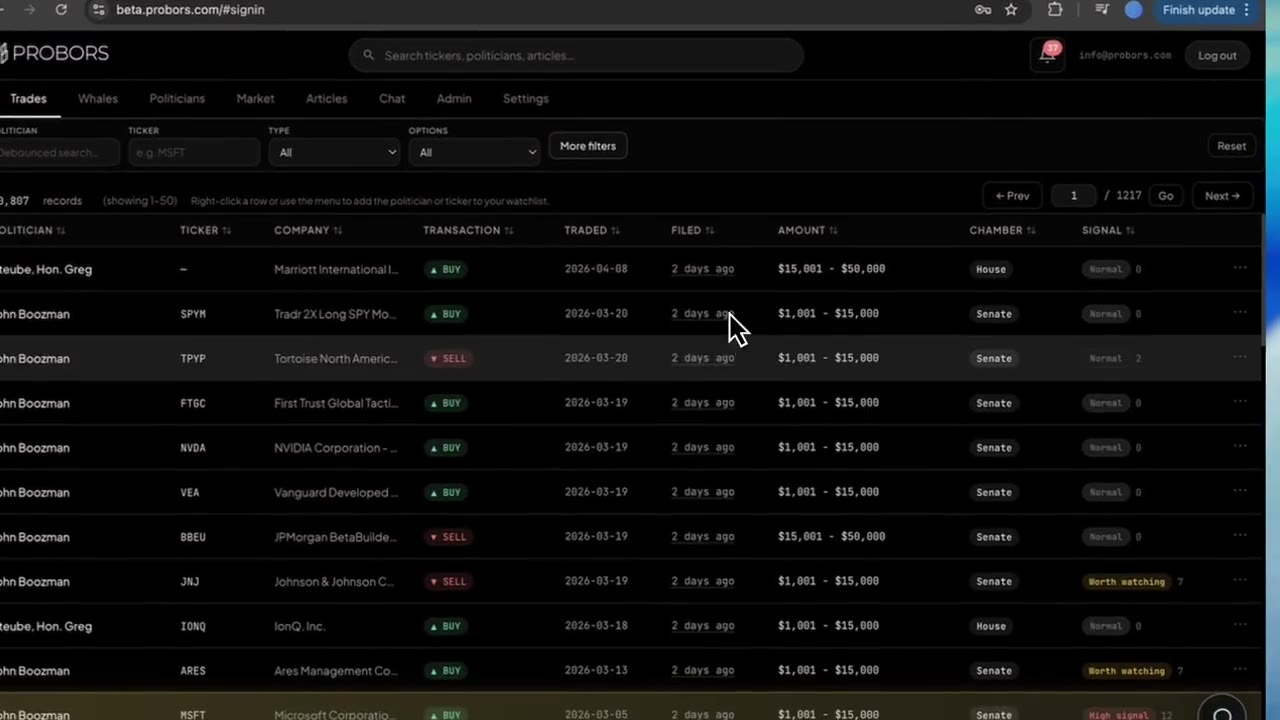
- Switch to the Trades tab with the same ticker to scan congressional PTR history for separate politician activity.
For a broader workflow, see how to triage whale transactions on ProBors and the ProBors Whales tab guide.
What this does not prove
A November officer-selling cluster on LYV does not tell you:
- Whether Rapino or Berchtold sold on a discretionary timetable or under a pre-announced Rule 10b5-1 plan (footnotes on EDGAR decide that)
- That management is bearish on Live Nation’s prospects—large-cap officer sales are often diversification or tax-planning events
- That politicians traded ahead of the same Form 4 wave (no congressional rows in ProBors tie to November 12–13, 2026)
- That the stock will rise or fall based on insider flow alone
- Exact post-trade holdings beyond what each Form 4 reports
Officer sales are disclosure events, not trade recommendations. The useful output is a verified timeline of who filed what, when, under which SEC transaction code—not a headline that “insiders sold $54 million.”
FAQ
Why does LYV rank on the whale board with only six prints?
Net reported value matters. The LYV board line shows about $16.1 million in net outflow across 6 whale-class prints in 14 days—enough to rank second in late November even when print leaders like ROKU post far more lines.
Were Rapino’s three November 12 sales separate decisions?
They are three Form 4 lines on one trade date, totaling about $35.4 million in reported open-market selling before counting November 13 lines. Treat them as one cluster for research; verify split-tranche logic on EDGAR.
How do the Rapino and Berchtold sales relate to option exercises?
ProBors shows 4 code M exercise rows in the same filing window with about $8.1 million in positive reported value. Exercises often pair with sales for tax withholding or liquidity—read footnotes before calling the week a pure open-market exit.
Is there congressional trading on LYV tied to this whale wave?
ProBors shows House partial sales from April McClain Delaney in July–August 2026 and older rows—not concurrent with the November 12–13, 2026 officer filings. Cross-chamber research still matters, but the timelines are separate.
How often should I re-check LYV whale data?
Form 4 ingestion updates on a regular schedule. Confirm freshness on probors.com/status before citing rows in memos or publications.
Track LYV whale flow on ProBors
Filter Live Nation Form 4 whales by signal score, compare the November officer cluster to the 14-day leaderboard, and cross-check congressional PTR history on one ticker page.
Get startedRelated reading
- Top whale tickers in late November 2026
- How to triage whale transactions on ProBors
- APPF whale insider sales explained
- How to combine congress and insider research
- Form 4 vs Form 144 insider filings
Sources
- SEC Form 4 overview — reporting requirements for insiders
- SEC EDGAR search — verify individual Form 4 filings
- SEC Rule 10b5-1 trading plans — context for planned insider transactions
- House Financial Disclosure — periodic transaction reports
- Rows were checked in ProBors and should be verified against the original filing.
- Ingestion health: probors.com/status
Sources & methodology
Last updated:
ProBors uses public disclosure records, SEC filings, House and Senate financial disclosure portals, market data, and in-product workflow checks. Articles are written as research education, not investment advice.